You Lost the Weight. You Still Can't Get Down on One Knee.
Every headline this year said the knees would follow the scale. Yours didn't — the stairs, the car door, the step you've done ten thousand times. Here's why the movement didn't come back with the weight — the footnotes the headlines left off — and which part of it you can actually change.

Nothing here is medical advice. If you're on a GLP-1, it stays exactly where your doctor put it — nothing on this page is a reason to start, stop or change a prescription.
Losing the weight was never the whole job.
The study everyone shared this year has a paragraph in it that almost nobody read. It's about the control group.
In the 2026 Cell Metabolism study, a Chinese Academy of Sciences team gave semaglutide to mice with osteoarthritis. That part made the headlines. The part that didn't: they diet-controlled the untreated mice so both groups lost exactly the same weight.
If the knee benefit were simply about weight, the two groups would have looked the same. They didn't. Only the treated knees showed protected cartilage — and a small human pilot (20 people, 24 weeks) showed thicker cartilage on MRI. The paper's own title calls the mechanism weight-loss-independent.
Sit with what that means for you. Taking the weight off, on its own, wasn't what changed the joint in that study. Something else was being done to the cartilage — something about its fuel supply. Stressed cartilage cells run on an inefficient energy pathway; the drug appeared to switch them back to a healthier one.
If cartilage has a supply that can be starved or fed — what feeds it?
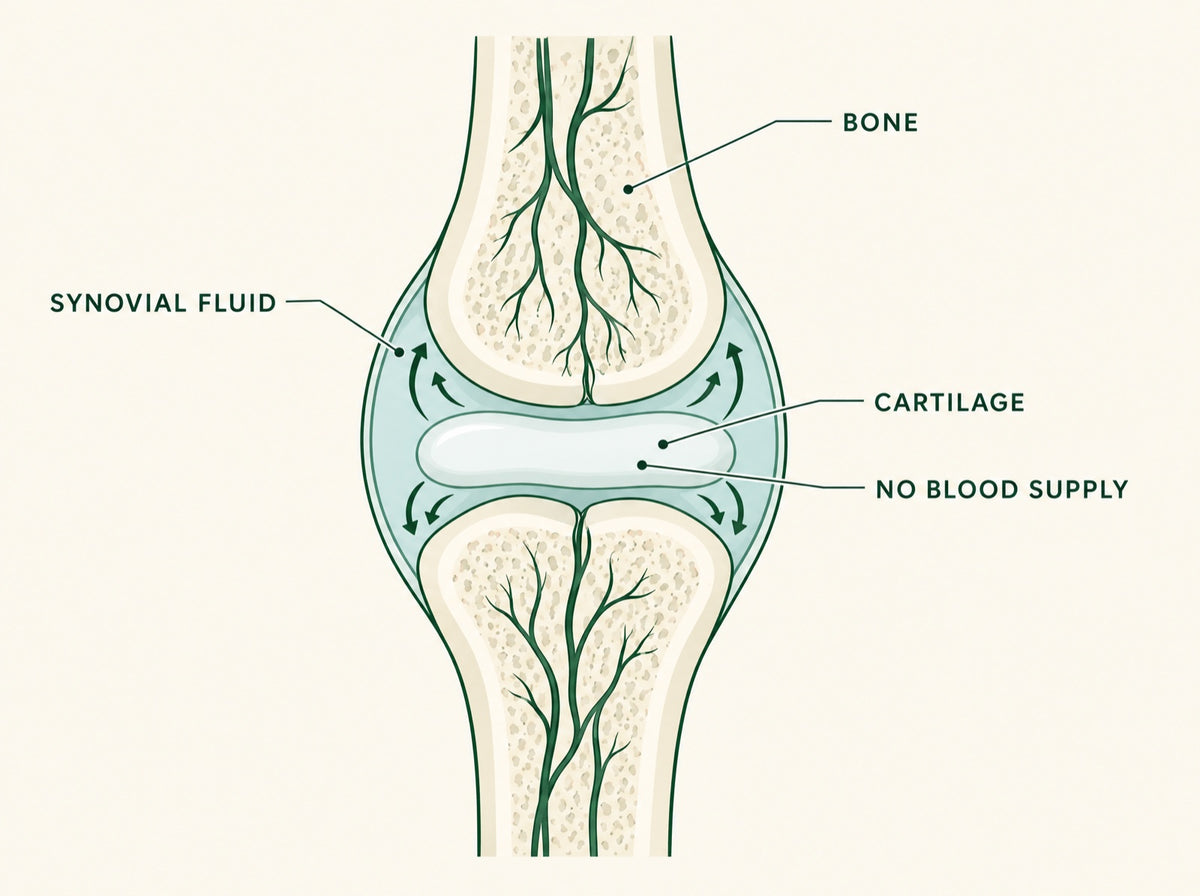
Cartilage has no blood supply — none. It can't pull nutrients out of your bloodstream the way muscle or skin does. It's a sealed cushion between two bones, and it feeds like a sponge: it drinks the fluid inside the joint, and every step squeezes old fluid out and draws fresh fluid back in.
That fluid is the only way in. You can take forty pounds off a knee and leave the room it eats from exactly as it was. That's one factor worth understanding when the weight came off and the movement didn't — not a verdict on any one knee, yours included.
Twenty people and mice. It's early science and the researchers say so — it's not a reason to change anything your doctor prescribed. Losing the weight matters, and the trials back that up; this is simply a reason to look at what else, besides the scale, might be part of the picture for you.
- STEP 9, NEJM 2024 — 407 people, 68 weeks; 13.7% weight loss vs 3.2%; knee-pain scores improved 41.7 vs 27.5. The strongest human evidence in the set. Bliddal et al., PMID 39476339.
- Cell Metabolism 2026 — the control-group study above. Qin et al., PMID 41666927.
- Regional Anesthesia & Pain Medicine 2026 — health-database study; about 5% fewer knee replacements over eight years for those on a GLP-1 for three.
- What the researchers themselves say when asked: weight loss remains the most effective thing we know of for knee arthritis, and the rest is early. Every one of them.
You're lighter. You're not steadier. That's the gap you can feel.
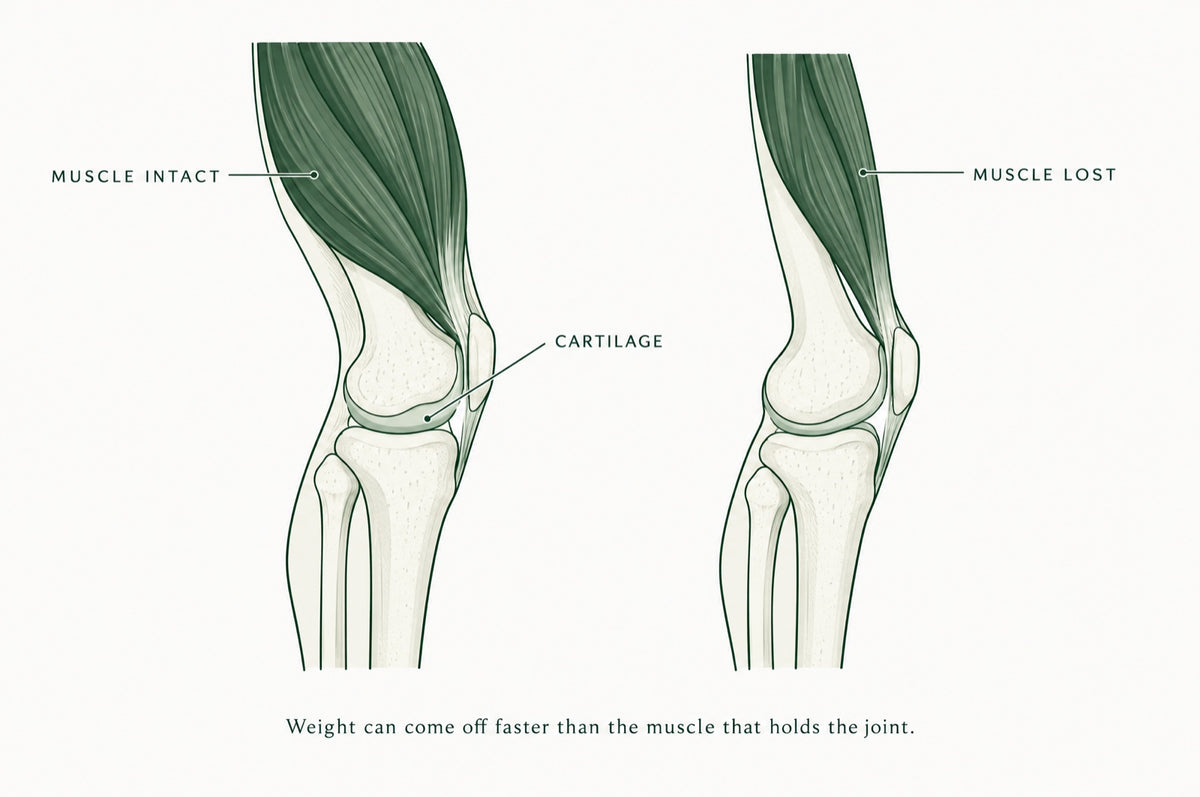
Look at what didn't come back: getting down on one knee. The step up into the truck. Car to the door. Off the floor without a hand. Those aren't strength moves and they aren't pain moves — they're stability moves. The knee has to hold its line under load while you're on one leg.
What holds that line is the muscle around the knee. And here's the footnote nobody reads: appetite-suppressing medication doesn't only spend fat. Eat less for a year without lifting anything and the body spends muscle too.
So the maths cuts both ways. A 2005 study in Arthritis & Rheumatism (Messier et al.) measured that each pound of body weight lost takes roughly four pounds of load off the knee per step — forty pounds off is a hundred and sixty pounds less through the joint on every stair. That's real, and it's why the stairs felt kinder for a month. But if the thigh that steadies the knee got smaller at the same time, you're carrying less and holding it less well. Lighter and less supported.
Orthopaedic clinics now say this out loud: the two things they watch in patients on these drugs are muscle loss and bone density. Neither is on the graphic.
Protein. Strength work — the balance class, the leg work, whatever they set you. A conversation about bone. No supplement fixes this, and any page that tells you otherwise is selling. That's the second reason the movement didn't come back — and the one you fix in a gym, not a bottle.
Years of joint pills didn't bring the movement back either.
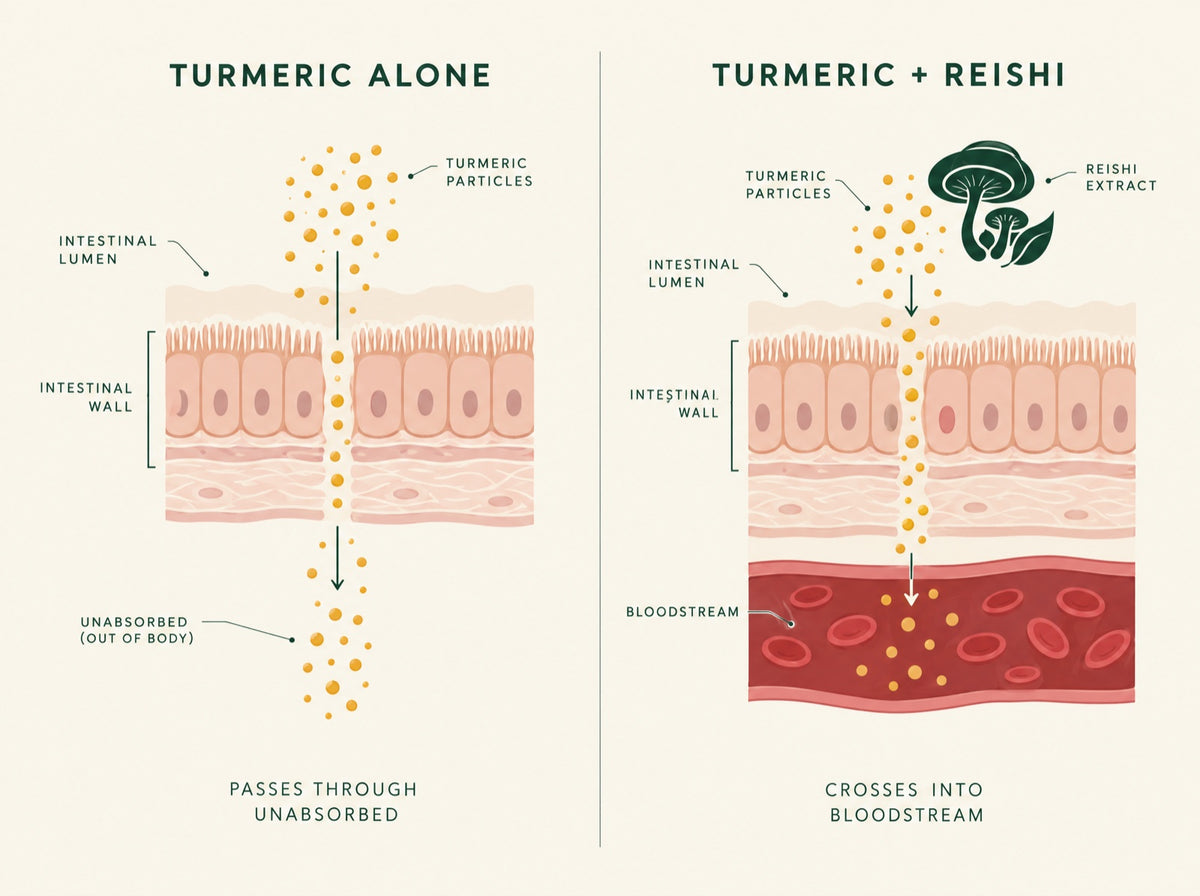
You've heard the two walls. We won't re-explain them — the anatomy of how cartilage is actually fed sits behind the label. What we'll add is what the two walls leave you with, because they're the only questions a label has to answer:
Wall one — how much gets absorbed at all? Turmeric is the comfort compound in nearly every joint formula on the shelf, and on its own its active compounds are poorly absorbed; most passes straight through. So the first thing to ask of any formula that leans on turmeric: is it paired with anything, or standing alone?
Wall two — how much of that reaches the joint fluid? Cartilage sits downstream of the joint fluid, not of a vein. No label can tell you the exact fraction that arrives. But it can tell you whether the core ingredients are in there at the doses that were actually studied — or as a sprinkle inside a "proprietary blend."
The question was never whether you failed the supplement. It's whether anything you were taking was built with the two walls in mind at all.
That's the third reason. Years of feeding the joint from the wrong side, then a year of lightening a joint that was still being fed from the wrong side.
The gap has three parts. Only one of them is a label's job.
Let's be straight about which.
| The part of the gap | Whose job | |
|---|---|---|
| The weight | You + your doctor | Done — and it matters. Keep doing it, and stay on the medication. |
| The stability | You + your doctor | Muscle around the knee, bone underneath. Protein, strength work, and a conversation about bone. |
| What the joint is fed | A label's job | The fluid it drinks from, and whether what you take was ever built to reach it — the only part a label can address, and the only part we'll talk about. |
What we make is a food supplement. It is not semaglutide, it does none of what the drug did in those studies, and nothing about it is a reason to change a prescription. It speaks to the third row. That's a small, honest claim, and it's the one we make.
You've been let down twice. Here's the honest reason to compare one more.
Once by years of pills that changed nothing you could feel. Once by a year of headlines that said the injection would sort the knee.
The reason to look again isn't that this is new, or that it's a gummy. It's that you now have a yardstick nobody handed you before — four things you can check on the back of any joint formula, ours included. If a formula fails them, don't buy it. If it passes, it's worth five more minutes of your attention.
1. Are the core ingredients at studied doses — or at a sprinkle? Glucosamine is one of the most-trialled joint ingredients there is, and the major trials used 1,500 mg a day. Many labels list 500 mg, or hide it in a blend. The number on the back tells you more than the promise on the front.
2. Is the turmeric paired with anything for absorption? Wall one. If a formula leans on turmeric and pairs it with nothing, ask why.
3. Does it do anything for bone and muscle — the two things the clinics are watching? The stability row is your doctor's. But vitamin D3 contributes to normal muscle function and the maintenance of normal bones, and calcium contributes to the maintenance of normal bones. A joint formula with neither wasn't built with someone on a GLP-1 in mind.
4. Is the routine one you'll actually keep when you're eating less? Not a quality point, a practical one. If you're eating half of what you used to, five capsules from three tubs is the first thing that quietly stops happening.
Against the four checks.
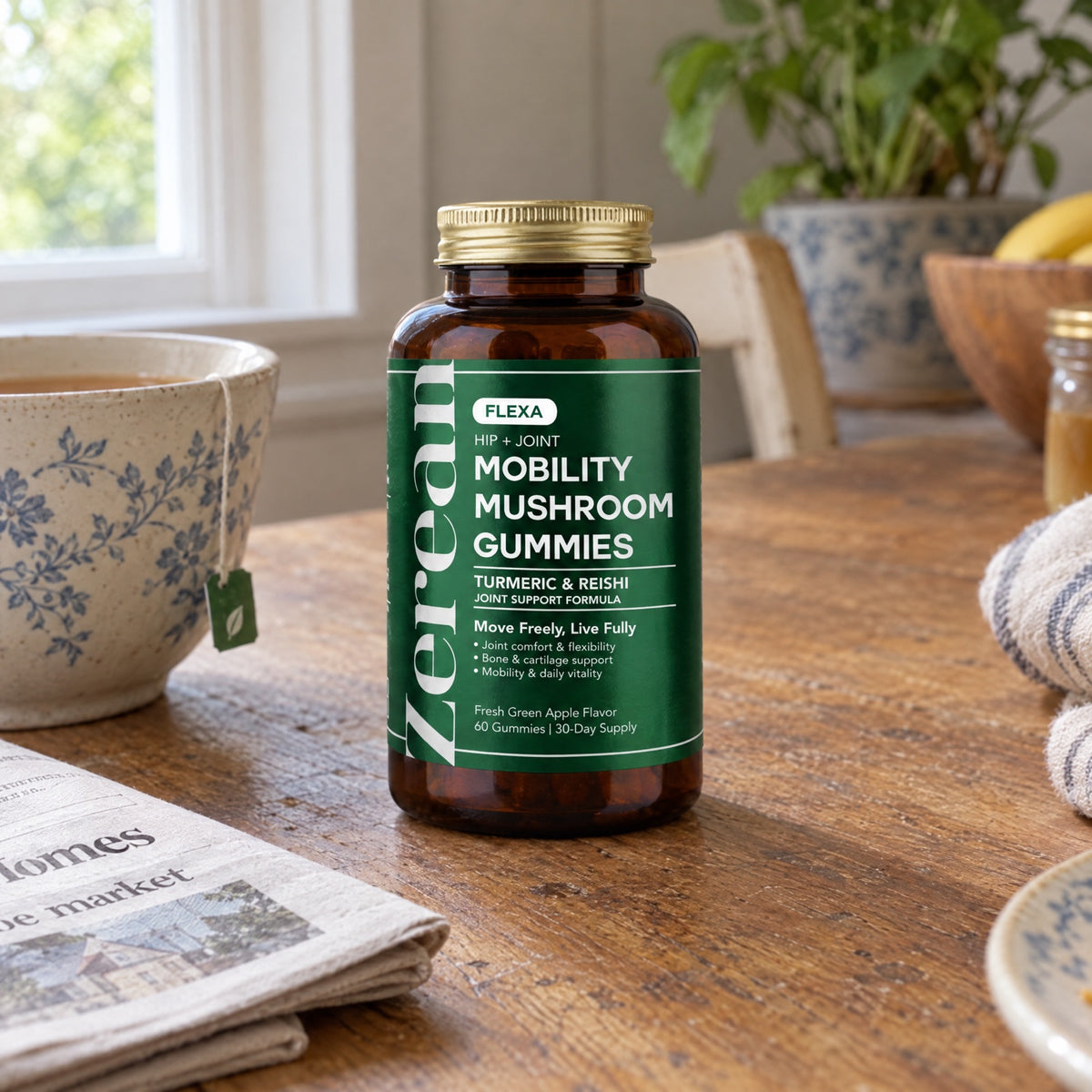
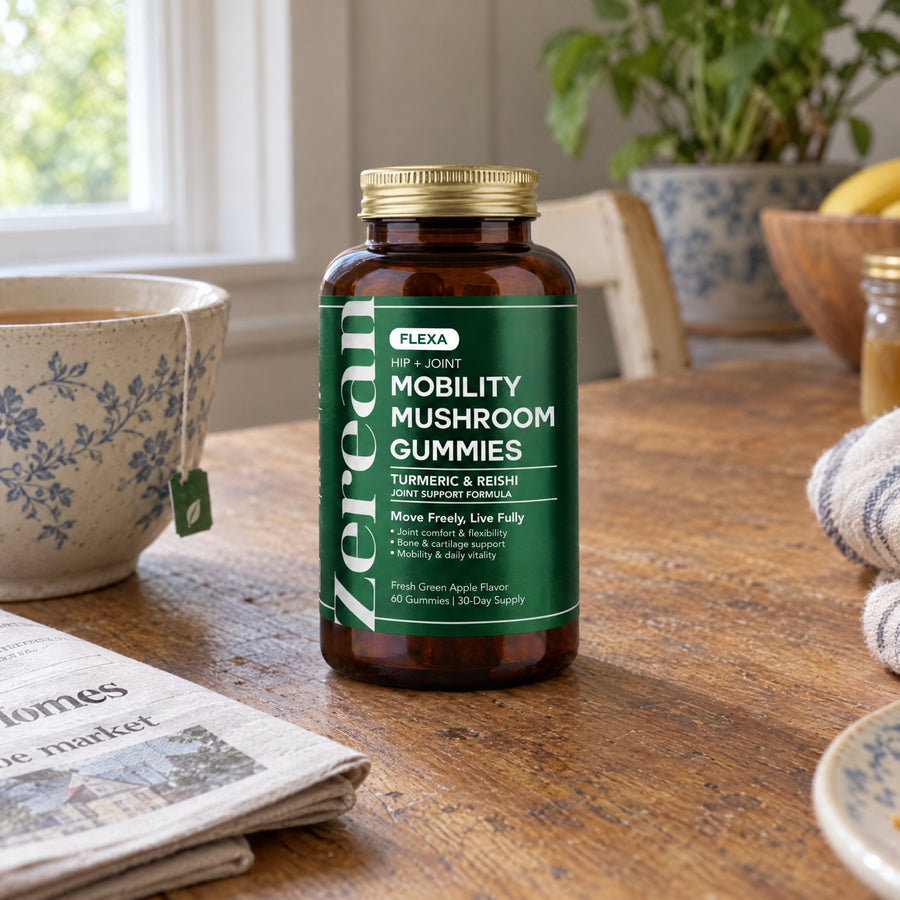
Doses: 1,500 mg glucosamine a day — the same daily amount used in GAIT and MOVES — with 800 mg chondroitin and 1,000 mg MSM. Real amounts, printed on the back.
Turmeric, paired with Reishi: 200 mg turmeric — and rather than leaving it to be poorly absorbed on its own, it's paired with Reishi. In our own testing, that pairing raised curcumin absorption by up to 99× versus turmeric alone. It's the pairing most formulas skip, and it's what the two walls are really about.
Bone and muscle: vitamin D3 and calcium in the formula — the two things the clinics watch.
Routine: two gummies a day. One formula, not four tubs.
Tested as ingredients, in real trials.
Glucosamine and chondroitin were tested in GAIT (NIH-funded, 1,583 people, 1,500 mg glucosamine a day; the overall result against placebo wasn't significant, though the moderate-to-severe pain group showed a signal) and in MOVES (606 people, six months, head to head against celecoxib, comparable results). Those trials tested the ingredients, not any finished product — ours or anyone's. Which is exactly why the label is the thing to compare.
One thing to set straight before you go further. Flexa is raw material for the joint, not a painkiller, and it doesn't regrow cartilage — nothing you can buy does. It works on a clock of weeks, not days, and the thing to watch isn't a pain score: it's the step, the car door, getting off the floor. What to expect, and when, is below.
Your first bottle, 46% off
First order only, one per customer. Free shipping on orders over $80. Regular price $64.99.
4.7 on Trustpilot · GMP-Certified · Third-Party Tested
Judge it by the everyday things, over weeks.
You can't feel cartilage being fed in an afternoon. Glucosamine, chondroitin and MSM are raw material, not painkillers — delivered daily, doing quiet work over weeks rather than days.
So the honest way to judge it isn't a pain score on any single morning. Two gummies with breakfast, and watch the everyday things over time — the stairs, the car door, getting up off the floor — taking stock after a couple of months rather than day to day. Some people notice a change and some won't, and we'd rather say that plainly than promise you a date.
Questions people ask before their first bottle
Flexa is a food supplement — glucosamine, chondroitin, MSM, turmeric, Reishi, vitamin D3 and calcium. Most people take it with breakfast. But you're on a prescription, so ask your doctor or pharmacist before adding anything, and don't change your medication because of an article. We'd rather you asked.
No. Those studies were of a prescription drug, and the cartilage findings are early — mice and a 20-person pilot. Flexa supplies raw material the joint is built from, at studied doses, in a formula built with the two walls in mind. That's a different and much smaller claim, and the only one we make.
There can be a few reasons a past supplement didn't help — dose, form, absorption, or simply not being a fit for you. Rather than guess which, hold your old label up against the four checks above and compare. That's what they're for.
It isn't a painkiller and we won't pretend otherwise. It supplies the material cartilage is built from. That's a slower, different thing than muting a signal — and the thing to watch is the step, not a pain score.
No. What you see is what you're charged, once. If you'd like it sent automatically you can choose that at checkout, and change or stop it whenever you like.
Customer Reviews